Minggu, 20 Juli 2014

Things TK Noticed in Korea

As some of you may have noticed, TK has been in Korea for the last couple of weeks. One of the pleasures of visiting Korea is to observe the changes. Because Korea is such a fast-changing society, even one year in between the visits (as was the case with TK's) is enough to produce noticeable, interesting changes. Here are three things that TK noticed in his visit:

(1) Beer.   Good beer is mainstream. Good beer is mainstream! In Korea! In the land of horse piss beer! Yes, it is true, good beer is available in Korea to a degree that has never been seen before. As TK previously predicted, the microbrewery movement in Korea is finally taking off. Even the big boys--i.e. Hite and OB--improved their default beer and came out with more drinkable stuff. Microbreweries are now opening their own restaurants and pubs all over Seoul; it will be a matter of time before they spread to other large cities of Korea.

(2) Public Bathrooms.   Once upon a time--say, 10 years ago--using a public bathroom in Korea was a serious gamble. You had to avoid the dreaded "squat toilet" (and no, TK is not going to put up a picture here.) In about 90 percent of the times, there was no toilet paper. Cleanliness? Pfft, people tossed the dirty toilet paper into an open-faced trash can.

Not so any more. In no case was TK in any danger of not finding toilet paper in a public toilet. All of them were reasonably clean--even the ones in incredibly crowded subway stations. The bathrooms in the Gangnam station smelled less of urine than the elevator of the Penn Station subway stop in New York. This is true.

(3) Chinese people.   There are more Chinese folks in Korea than ever. Tourist districts of Seoul have huge banners in Chinese. Thanks to a new investment visa, Jeju Island has a massive increase in Chinese folks in the last few years, to the point that Koreans are joking about how they need to learn Chinese if they want to retire in the island.

Got a question or a comment for the Korean? Email away at askakorean@gmail.com.

Minggu, 13 Juli 2014

Book giveaway winners!

First, the answers to the trivia:

1.  SM Entertainment is the management company of the pioneering female idol star, BoA.
2.  Shin Dae-cheol is the guitarist for the band Sinawi, whose bassist at one point was the legendary Seo Taiji.
3.  Kim Min-gi is the artist whose best known song is the Morning Dew.

Somehow, Question 2 tripped up a big number of entrants. The question asked for the name of the guitarist of the band, but many submitted "Sinawi" as the answer.

Many people still got all three questions correct, and sent terrific stories that made TK's heart all warm and fuzzy. TK picked the best three. Congratulations, Evan T., Michael L. and Larissa F.! You will receive an email from TK soon. For everyone, thank you so much for reading!

Got a question or a comment for the Korean? Email away at askakorean@gmail.com.


Kamis, 03 Juli 2014

Book Giveaway Trivia Time!

Dear readers,

The good folks at Tuttle Publishing, one of the best publishers of books on Asia, have sponsored an exclusive book giveaway event for Ask a Korean! readers. The prize? K-Pop Now! by Mark James Russell, which the Korean previously reviewed here. For anyone who needs an introductory overview of the current K-pop phenomenon, it is a great introduction.

For the give away, TK has put together a trivia competition. The questions and answers are from this blog's series on 50 Most Influential K-Pop Artists, available here. TK will keep the competition upon until noon (Eastern Time) of Friday, July 11. Please submit the three correct answers, and a good story about how you came across the blog and why you keep reading it. The top three will receive the prize mailed, no matter where they live in the world.

Here are the questions. Please remember to add your own story in addition to the answers to the trivia. Buena suerte.

Trivia Questions!

1.  This pioneering idol singer debuted at age 14, after having learned Japanese by living in the house of an NHK news anchor as a child. What is the name of her management company?

2.  K-pop legend Seo Taiji began his career as the bassist for this heavy metal band. What was the name of the guitarist for the band?

3. This artist is likened to Bob Dylan, elegantly singing a theme of resistance against Korea's fascist regime during 1970. His best known song is called the Morning Dew. What is the name of this artist?

Got a question or a comment for the Korean? Email away at askakorean@gmail.com.

Senin, 30 Juni 2014

Sweet, Delicious Eff You

Dear Korean,

Reading this article, I was wondering whether the statement "The popular pumpkin toffees have become a shorthand for an insult in South Korea, where 'Go eat toffee' means a ruder version of 'get lost'" is true. Is there even a "tradition" to throw toffee? In my culture we throw sweets and candies as a sign of good luck and happiness.

Curious Reader


A bit of background first. As this blog (unfortunately) predicted, Korean national soccer team returned from the Brazil World Cup with a disappointing result of two losses and one draw.

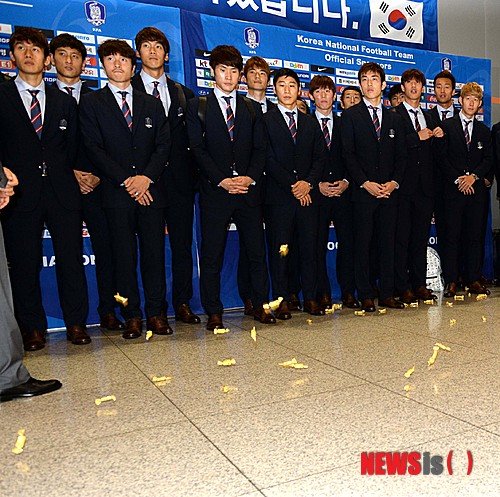
Upon their return, they were greeted with a toffee shower:

Note the toffees on the floor.
(source)

So yes, it's true: throwing toffee is an insult. But why? That question becomes fairly easy to understand when one sees what a traditional Korean toffee looks like. It looks like this:

Sweet and delicious.
(source)
This is called 엿 [yeot] in Korean. "Toffee" is a solid translation, because that's what yeot is--it is a candy created by solidifying thin strands of syrup. The insult is to say 엿 먹어라, or "eat yeot." Hm, put this long, sticky thing into your mouth? Wonder what that could possibly mean?

(For those lacking in imagination, it means: "Eat a dick.")

Interestingly, this insult is more often delivered with words rather than with the actual candy. In the right context, gifting the candy is not an insult at all. For example, someone who is preparing for an exam often receives yeot as a gift, as an encouragement to "stick" the exam (=pass the exam.) But of course, there is no mistaking the intent behind the toffee shower that the the national team received.

Several of you also emailed to ask how the Korean felt about the way in which the players were received. His feeling is: they probably don't deserve it, but it is part of the job description. Certain players--Son Heung-min comes to mind--played their hearts out, and definitely did not deserve to be told to "fuck off." Ideally, one should be able to focus-fire the insult. If one threw the yeot only to those who deserved the most blame, striker Park Chu-young and goalie Jung Sung-ryong would be getting a cannonball of candies to their faces. 

(And Jung won't be able to catch a single one of them. Hey-oh!) 

But that's what sports stars are. They are not paid big money to put a ball through a goal or a hoop or into the end zone. They are paid to serve as the vessel into which we project our desire. In this instance, Korean people's desire was hardly unreasonable; it is not as if there was an expectation that the team would win the whole thing. The team was expected to play hard, and play competently. More than a few players on the team failed at this. And if all they receive in return is some candies thrown at their face, that is not a huge injustice.

-UPDATE: July 3, 2014-

1.  Renowned food blogger Joe McPherson, who blogs at Zenkimchi, lodged this objection:  "Yeot is more like a taffy than toffee." Truth be told, TK did not even realize there was a difference between taffy and toffee. Alrighty then.

2.  This post was featured on Deadspin, in which some of Deadspin's commenters questioned why the yeot showing in the photos taken at the airport does not look like the yeot photo in this post. The reason is actually pretty simple: in the era of commercialization, the traditional long yeot has been re-packaged into a bite-sized candy. The bite-size yeot is still quite enough to convey the insulting message, and has the bonus of being a better aerial projectile.

3.  Now, for the really fun part. Since this post went up, a number of Korean readers provided several alternate theories as to why "eat yeot" is an insult. The theory that TK presented in the post is the prevailing theory: that yeot looks like penis, and "eat yeot" means "eat a dick." But the alternate theories are plenty interesting in their own right, so here they are:

- Probably the most colorful theory is that "eat yeot" comes from a botched exam in 1969. In the middle school entrance exam of 1969 (yes, Korea used to have an entrance exam for middle schools,) there was a question about the appropriate coagulating agent in the yeot-making process. Because of a mistake, there were two possible answers, but the testing authorities only recognized one of the answers. The enraged parents of the students then mobbed the testing authorities, shoving a homemade yeot made with the alternate substance into the faces of the befuddled testing authorities, screaming: "Eat this yeot! Eat it!"

This event actually did happen, but it is almost certainly not the origin of the phrase "eat yeot" because there are examples of "eat yeot" usage that pre-dates 1969. But it's a fun story.

- One alternate theory says:  "eat yeot" means "shut up," because apparently there is a Western tradition in which the dead's mouth was filled with thick syrup to keep it closed. This is most likely a wild speculation.

- Another alternate theory says:  "eat yeot" is a bastardization of "eat yeom" [염 먹어라]. "Yeom" is a process by which Koreans prepare the dead body for the funeral. That is to say--the theory is that "eat yeot" really means "go die." TK does not think this is particularly compelling, because yeom is a process rather than a substance that actually goes into one's mouth.

- There is even a dispute as to whether "yeot" refers to a man's genitalia. One of the leading theories is that "eat yeot" is a slang term originating from Namsadangpae [남사당패], a famed circus/clown act in Korea that has survived for centuries. According to the Namsadangpae lingo, yeot actually refers to vagina rather than penis.

Got a question or a comment for the Korean? Email away at askakorean@gmail.com.

Minggu, 22 Juni 2014

Korea was never a Part of China

Dear Korean,

I’m from Singapore and visited Korea for the first time last week. I went to the National and National Folk Museums in Seoul, and noticed that the Koreans talked mostly of their early relations with China as one of “international exchange” or “cultural exchange”, seemingly having forgotten that Korea was a vassal state of the Chinese empire and paid tribute to it in order to maintain autonomy. Will the Koreans never admit to having been part of China? 

Keith


Short answer: Koreans will never admit such a thing, because Korea has never been a part of China.

The confusion most comes from misunderstanding the term "vassal state." The concept of "vassal state" (alternately known as a "tributary state") does not really exist any more, nor has it truly existed in the history of the Western civilization. But it does vaguely sound like "colony" of the early 20th century vintage, which leads to the confusion that Korea was a part of China. That is simply not the case. "Vassal state" is a diplomatic concept that was unique to pre-modern Northeast Asia. The concept must be understood within that context, because it makes no sense outside of it.

(It must be noted that nationalistic Chinese and Japanese deliberately sow this confusion. By doing so, nationalistic Chinese exaggerate the reach of the Chinese Empire; nationalistic Japanese justifies Imperial Japan's invasion of Korea, by claiming that Korea was simply going from one colonial master to another.)

Depiction of Korean tributary envoys to China, by Kim Hong-do, circa late 18th century
(source)

Put yourself in pre-modern Northeast Asia for a moment. There is one nation in the center--China, or 中國 (literally, the "center country")--that has been clearly superior to all nations surrounding it in every aspect of civilization, including military, trade, arts, philosophy and science, for two thousand years

Stop there, and let two thousand years sink into your brain. Think hard about how long that time is. Think about how old your grandparents are, and think about how many more generations you have to travel upward to hit two thousand years. Think about how much of our current tradition we take for granted, and how old those traditions are. Americans love to talk about their democratic tradition, but the age of that tradition is barely more than ten percent of the Chinese empire's history. Americans look to Europe for a deeper tradition, but European tradition prior to the Renaissance--which began in the 14th century--was nothing to write home about. 

This exercise is necessary because we the modern people often get myopic, and think that beliefs of the past are dumb or absurd. Not so: if Chinese hegemony has been true for two thousand years, it is simply true to anyone living within those two thousand years in China or near China. It is like living next to the Roman Empire that never went away until the 20th century. In such a situation, it would actually be irrational to think anything other than that the world revolves around China.

In those two thousand years, Northeast Asia was a "sinosphere"--a vast region in which China acted as a center of gravity of every aspect of human civilization. Of course, other nations in the region, including Japan, Vietnam and Korea, developed their own civilization which was quite glorious in its own right. But every nation in the sinosphere shared roughly the same governing philosophy, religion, social structure and writing system, all of which ultimately originated from China.

In this sinosphere, the emperor of China naturally considered himself to be the ruler of the entire civilized world. To the Chinese empire, the entire world consisted of: (1) China, (2) civilized nations that are vassal states to China (i.e. having a diplomatic relation with China,) (3) civilized nations that are not yet vassal states to China ( i.e. having no diplomatic relation with China,) and (4) uncivilized barbarians. During the Qing Dynasty in the early 19th century, China even considered the Netherlands, Portugal, Italy and England to be China's vassal states.

Informed by Confucianism (the shared ideology in sinosphere,) there was a mutual obligation between China and its vassal states. China provided vassal states with governing legitimacy, military security and (relatively) free trade. Vassal states, in return, provided a pledge of loyalty, acceptance of the Chinese emperor as the ultimate governing authority and regular tributes.

(More after the jump.)

Got a question or a comment for the Korean? Email away at askakorean@gmail.com.


Now, for the important part. Vassal states pledge loyalty to the Chinese emperor and give regular tributes. That's it. Vassal state had no other formal obligation to China. Vassal states had its own king, and had its own manner of choosing its king. Vassal states had its own government, which independently governed its own country. Vassal state collected its own taxes and had its own military. Throughout its relation with China before the modern times, all of the foregoing was true for Korea as well. China never chose any king on Korea's behalf. China had no formal role in forming Korea's domestic policies. China had no authority over ordinary Koreans, and China's authority over Korea's royal family was symbolic rather than real.

One may ask: what about the tributes? Is that not a tax that Korea paid to China?

No. The word "tribute" evokes an image similar to "tax," but it does not mean what you think it means. Recall that the relationship between China and its vassal states (including Korea) was based on Confucianism, which provides for a hierarchy with mutual obligations. Casual observers often say Confucianism is hierarchical, while losing sight of the fact that under Confucianism, there are obligations that run both downward and upward within the hierarchy. Even as the subordinate recognizes the authority of the superior, the superior must play its part to earn the authority.

In the context of sinosphere, this meant that the Chinese empire repaid every tribute. In fact, this is how the tributary system worked in sinosphere: the vassal state sends the tributary gifts as a sign of respect for China's authority. Upon receiving the gifts, the Chinese emperor would send back his own gifts to the vassal state's ruler as a sign of appreciation. This is hardly a tax on Korea; it was a trade between Korea and China under a different name.

There are ample historical evidence to show that both Korea and China recognized, as a practical matter, that Korea's tribute was a trade rather than a tax. For example, in the early days of Joseon Dynasty, China's Ming Dynasty required that Joseon pay tribute once in three years. But Joseon Dynasty vigorously insisted that it would pay tribute three times a year, and did end up paying tribute three times a year, and eventually four times a year. This makes no sense if the tribute were a tax; nobody volunteers to pay more taxes. Joseon Dynasty wanted to pay more tribute because it turned a profit on the return gift. [1]

Often, Joseon paid tribute by plying horses to the Ming Dynasty, which constantly needed horses to fend off barbarian attacks. The royal records from the Joseon Dynasty show that Korea did not send its own horses. Rather, Joseon purchased the horses from the Jurchens and re-sold the horses to the Ming Dynasty for ten times the price. [2] Being China's vassal state was particularly lucrative to Korea because outside of the tribute-repayment trade, China did not allow any international trade since the Ming Dynasty. [3]

The modern parallel to this relationship is not the colonial holds that appeared in the late 19th and early 20th century. The modern institution that is the closest to the sinosphere's tributary system is the British Commonwealth. Did you know that Canada and Australia had a queen? A number of states within the British Commonwealth--including Canada and Australia--still consider the British queen to be their head of state. Governor-General of Canada, who is appointed by the British Queen, summons the Canadian Parliament; Governor-General of Australia, who is also appointed by the British Queen, has the authority to dismiss the Australian government. (And in 1975, this authority was actually exercised.) Based on the foregoing, one could perhaps make an argument that Canada and Australia were a part of the United Kingdom. But given that Canada and Australia have their own governments just like Korea throughout its history before the 20th century, few would take that person seriously.

-Notes-

[1] From 이덕일, <조선 최대 갑부, 역관>
[2] Same.
[3] It must be noted that some Korean historians are skeptical of the claim that the tributary system always resulted in Korea's financial profit. See, for example, 계승범, <조선시대 해외파병과 한중관계>. But even those scholars generally agree that Korea clearly benefited in the non-economic sense, in the form of China's military protection, importation of books, art pieces and luxury goods, emergency lines of credit during famine, etc.

Got a question or a comment for the Korean? Email away at askakorean@gmail.com.

Senin, 16 Juni 2014

World Cup Thoughts

Yes, the Korean realizes that he is far overdue for a post. In his defense, how can one write a lengthy post when there are so many excellent games to watch?!

I mean, just look at this amazing Van Persie goal. I could watch this all day.


Actually, forget that. I could watch THIS all day.


Every flying man deserves a cape.

Which brings us to Team Korea, which takes the pitch tomorrow against Russia. Unlike the Korean's other homeland--the United States, conquerer of the Black Stars--Team Korea belongs to the soft, soft "Group of Life." Other than Belgium (the "sudden juggernaut,") all three teams in the group--Korea, Russia and Algeria--seem to have a legitimate chance of advancing. On paper.

But don't be fooled by the paper. Haven't you learned anything from the papers like the New York Post? Or the papers that constituted credit default swaps which suddenly became a value-destroying black hole? Papers lie, and they lie about Team Korea's chances. This Korean team is one of the worst Team Koreas in recent memory. Everything about them is terrible. The defense is a never-ending horror show, the offense too young and too green. The team treats scoring chances like a nerdy teenager running into a supermodel. Instead of confidently approaching the object of desire, they blubber, kick about wildly and then explosively self-destruct.

You think the Korean is joking, but he emphatically is not. Just look at this chart of least favorite teams compiled by the New York Times. Obviously, Korea's least favorite team is Japan because obligatory. But Korea's second least favorite team? Team Korea. Our nationalism is not so great that we root for crap. When we see crap, we hate it, even if it ends up being self-hate.

So, that's Team Korea's World Cup chances in a nutshell. It would be lucky to salvage two losses and a draw, while giving up no more than two goals in either losses. (There is a real chance that Korea could lose 5-0 to Belgium. Mark my words.) Team Korea is that sick puppy that you picked up from the side of the road, that mangy one which would surely die in a couple of days. Like your parents said, don't get too attached. Just sit back, quietly mutter "Well, at least we made the Cup," and thank your lucky stars if you have another country that you may legitimately root for. In that spirit:  USA! USA! USA!

(Seriously though, I really want Korea to win. Just one game. Is that too much to ask?)

Got a question or a comment for the Korean? Email away at askakorean@gmail.com.

Sabtu, 31 Mei 2014

The Sewol Tragedy: Part III - The Fallout


The capsized Sewol
(source)

One cannot get away from events in this age; the 24-hour news coverage and the Internet would not allow it. The Sewol disaster unfolded in real time in front of a horrified nation. When more than 300 lives--vast majority of them children--senselessly perish in an entirely preventable accident, it cannot help but affect the public. Similar reaction occurred in the United States, following the mass shooting in Newtown, Connecticut, in which dozens of young children died at the hands of a deranged shooter. 

But as horrific as it was, the Newtown shooting was over within an hour. Not so with the Sewol sinking. The ship sank for more an hour. The rescue effort subsequently unfolded for days, on live television. In the aftermath of the disaster, every last bit of incompetence from every corner of Korean society was magnified, amplified. It drove Koreans toward self-loathing, cynicism, and finally anger toward the political system.

What do You do When Everything Falls Apart?

The saying goes:  failure is an orphan, but success has a million parents. But in the Sewol disaster, the devastating failure had a million parents:  the captain who abandoned the ship, the ferry company that dangerously overstocked the ship, government that let deregulation run wild. Unfortunately, the failures did not stop when the ship sank. The hits continued to come from all directions: from the media, the government and the society as a whole.

*               *               *

First, the media. Purely from the perspective of mental impact, perhaps the most devastating error was the media's early reports that everyone aboard the Sewol was rescued. The cause of this error is under investigation, but it appears fairly clear that the media reported an unconfirmed rumor in the race to break the news first. This misfire significantly impacted the manner in which Korean public processed the news. When Koreans first learned the news about the Sewol sinking on the morning of April 16--around 11 a.m., 30 minutes after the ship completely capsized--they took it as a mildly scary event with no true harm done. The complacency set by the encouraging news made the full scale of the true horror much more destructive. Instead of no casualty, there were more than 300 missing, most of them high school students.

Got a question or a comment for the Korean? Email away at askakorean@gmail.com.


In the hours following the sinking, the media landscape in Korea was the lowest circle of hell in disaster porno. Because the Internet age came to Korea earlier than virtually any other country in the world, the issues that the Internet age created have affected Korea for longer, and more severely. The worst instincts for clickbaiting and sensationalism afflicted every part of the media, from tabloids to the more respected papers.

Newsis, an up-and-coming online newspaper infiltrated Danwon High School, and took a staged photo of a dead student by setting up an open notebook on the desk. Chosun Ilbo--the conservative newspaper that prides in its ability to steer Korean public opinion on any given issue--released an article discussing which insurance companies insured the Sewol, and what the expected payout was supposed to be while the ship was still sinking. Respected TV stations like SBS and jTBC harassed the freshly-rescued survivors for an interview. A reporter from SBS attempted to interview a six year old child, the rest of whose family perished in the ship. On a live television, a reporter from jTBC asked a rescued Danwon High School student if he knew his friends died, which caused the student to crumble in tears.

Second, the government. Much like the media, the government tortured the families of those aboard the Sewol as well as Korean public with a false promise: the possibility that there may be survivors in the capsized ship thanks to the supposed "air pockets." With a benefit of the hindsight, this promise was most likely illusory. Yet, if those in Korean government who were responsible for the rescue genuinely believed the possibility of air pockets, they moved far too slowly to capitalize on the opportunity.

Korea's Coast Guard did not have enough resources to rescue people from a capsizing ship, but other disaster-response authorities did. The Sewol's passenger made the first emergency call to the Coast Guard at 8:52 a.m. But the Coast Guard did not inform the Ministry of Public Security and Administration--which had more sophisticated rescue ships and helicopters to deploy--until 9:30 a.m. In fact, the Ministry first learned the accident from the television news rather than its subordinate. It was not until 9:31 a.m. until the Blue House was notified. By then, the ship was three minutes away from the point at which no escape was possible.

Further, the initial report to the government said nothing to indicate that a massive disaster was unfolding; it simply said that the Sewol was sinking, and the rescue was in progress. Incredibly, even after 5 p.m.--half a day after the ship sank--it appears that President Park Geun-hye did not have a clear idea of what exactly happened. During her visit to the rescue central, the President asked why the students could not be saved if they were wearing life jackets--implying that, in her understanding, the Sewol's passengers were floating in the sea rather than trapped inside the ship.

President Park Geun-hye at the disaster central.
(source)
The President was hardly alone in not having a clear sense of exactly what happened. Until 4:30 p.m.--again, half a day after the ship sank--the rescue central could not even figure out exactly how many people were on board on the Sewol, and how many were rescued. At 2 p.m., the rescue central announced that 368 were rescued, only to halve the number at 4:30 p.m. to 164 rescued. (The final tally of rescued passengers is 174.) When the Blue House was criticized for not having adequate information about the disaster, a senior Blue House official gave a tone-deaf response that the Blue House was not the "control tower" for disasters. While technically correct, this type of response could not help but give off the impression that the government was abdicating its duty to keep people safe.

Allegations of graft and corruption also emerged even as the rescue was progressing. There were allegations that the Coast Guard prevented the Navy divers from entering the water, such that the Coast Guard's private contractor (called Undine Marine Industry) could send its divers first. This led to suspicion that the Coast Guard delayed the rescue effort for the sake of taking care of its contractor. Because the government initially represented that there might be survivors in the overturned ship, it could not avoid the severe criticism that they were wasting precious time to play favorites.

Third, the society. Nearly as soon as the news broke, the Internet trolls in Korea's cyberspace were out in full force. Within minutes after the Sewol sinking was reported on the Internet, the vilest comments imaginable began appearing on the news story. (Here is a selection of them. I will not translate.) When the picture of Park Ji-yeong (the heroic 22-year-old crew member who drowned after saving dozens of children) appeared on the news, scores of god-awful lewd comments appeared below. It came to a point where Naver, Korea's largest search engine, put up a notice urging its users to not add comments injuring the victims' dignity. The media packaged those trolling comments into another round of clickbait news stories, fueling further outrage.

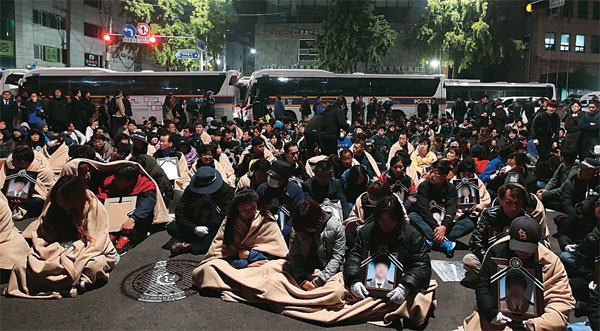
The situation was only slightly better offline. (Actually, it is not clear if it is better or worse that people were willing to say the same crap publicly.) Jo Gwang-jak, a pastor and the vice president of the conservative Christian Council of Korea said: "The low-income kids should have gone to a cheaper destination for their school trip. Why were they on a boat to Jeju and have this happen?" (Jo later resigned after much criticism.) Kim Si-gon, the head of new reporting at KBS, suggested that the sinking of the Sewol was not a big deal because more people die from traffic accidents. The enraged families of the Sewol victims protested in front of the KBS overnight, demanding apology. (Kim later resigned.)

Families of the Sewol victims protesting in front of KBS.
Each one is holding a picture of the deceased, which is used in a Korean style funeral.
(source)
Insensitivity was only one part of the way in which Korean society turned into a monster in the face of the disaster. Soon after the news broke, Facebook and other social networking sites were flooded with photo captures of text messages and instant messages, supposedly sent by Danwon High School who were still trapped inside the ship alive. Families of the students desperately latched onto them. But they were all fake. When arrested, the fabricators of the messages said they were hoping to drive up the subscribers to their social networking site accounts so that they may later sell them.

There is an even more brazen case of celebrity-seeking. One woman, who claimed to be a rescue diver, gave a live interview with a TV station to claim that another diver heard survivors from inside the ship, but the government is letting them die by not allowing regular divers join the rescue effort. This was a lie, as she was not at all a rescue diver. (In fact, it was revealed later that the woman has a long history of lying to gain celebrity. In another instance, she claimed that she was a cousin of T-ara's Hwayoung to take pictures with idol groups.)

*             *             *

Major disaster like the Sewol sinking has not struck Korea in a decade, or two decades depending on how one qualifies a "major disaster" that is comparable to the Sewol sinking. In 2003, 192 people died in a subway fire in Daegu, but the fire was a result of an arson. To find a death-by-thousand-cuts disaster like the Sewol sinking, one may have to go back to 1995 when a department store in Seoul that illegally modified its structure collapsed, killing more than 500. By 2014, Koreans were gaining confidence that the bad old days were behind them.

The Sewol tragedy shattered that confidence. Every major institution of Korean society--the government, the media, the church, the civil society--failed to properly function in some form or another. This total failure stunned Koreans. Without any institution in which to place their trust, Korean public first recoiled in self-loathing: what were we doing, letting hundreds of young children die on an illegally modified ship? Then followed cynicism and despair: perhaps nothing can be done, because something ingrained deep inside Korea's culture that inevitably drew them toward disaster. The depression was widespread and palpable: consumer spending in Korea in the later part of April dropped like a rock, similar to the way in which Americans responded to the 9/11 terrorism.

Next came the indignation against those responsible of preventing this disaster. Why couldn't the Coast Guard save a single person from inside the ship? Why couldn't the Ministry of Public Security put together the disaster response team more quickly? And why couldn't the president figure out what was going on for more than half a day?

President Park's Katrina Moment

President Park Geun-hye had only been elected a year ago, in a solid victory after the hotly contested presidential election. Throughout the presidential campaign, the fact that she was the daughter of the late president and dictator Park Chung-hee hampered her numbers. One of the turning points of the presidential campaign was when Park courageously recognized that the reign of her father--who ruled the country for 16 years after taking power by rolling into Seoul with tanks--violated the spirit of Korea's constitution and delayed the advent of democracy in Korea. This historic apologia by Park Geun-hye played a key role in her election, as it allayed the voter's fears that Korea was not about to travel backward toward her father's dictatorship.

In its first year, however, the Park administration began assuming a dictatorial posture that was not unlike her father's. As soon as she was elected, it was uncovered that Korea's spy agency and the military were engaged in a massive operation to sway the election by adding Internet comments and sending out tweets over Twitter, amplifying the Park campaign's message. When the Supreme Prosecutor's Office began prosecuting the head of the spy agency, the Ministry of Justice ordered an audit over the SPO--which caused the Prosecutor General to resign rather than suffer the indignity.

Contrary to her campaign promise, Park began taking first steps to privitize Korea's railways. When the railway union went into a strike in protest, Park sent thousands of policemen to arrest the union leaders based on an arrest warrant that the court later quashed. When the police got the wind that the union leaders fled their offices and escaped to the building next door--which belonged to a liberal newspaper--the police took a battering ram the newspaper's offices and ransacked the premises.

The Sewol tragedy struck as the public confidence in the Park administration was on the decline. The tragedy, standing alone, was enough of a damage to the administration; one of Park's major campaign promises was to enhance public safety. Park even changed the name of the Ministry of Public Administration and Security to Ministry of Security and Public Administration, to emphasize the government's responsibility for public safety. But any support that Park garnered by leveraging the public safety angle went underwater with the Sewol.

Still, the Park administration could have handled the crisis better. But it did not. Instead, it turned toward its dictatorial instinct, treating the angered people as its enemy rather than the people whom the president was elected to represent.

The first sign of trouble occurred five days into the search process. The family of the Sewol victims, gathered in a gym in Jindo that served as a makeshift shelter for the families, became restless in anger. Someone suggested visiting the President at Blue House; immediately, a crowd of 300 formed. But they were stopped as soon as they stepped outside of the gym; a hundred policemen were waiting for them. As it turned out, the government had planted plainclothes police inside the gym to conduct surveillance on the families. The families tried to rent a bus to go up to Seoul, but the government already told all the bus companies in the area to stonewall the families. Desperate, the families began walking toward Seoul in the middle of the night, trying to cover 200 miles on foot. Nearly a thousand policemen forcibly stopped them at the bridge connecting the Jindo Island and the mainland. Even after this episode, the families of the Sewol victims came under constant surveillance by plainclothes policemen for signs of trouble.

The government also cracked down on criticism of the rescue effort, while tightening its control over the media. Daegu Metropolitan Office of Education censured an area public school teacher who criticized the president on Facebook. Program directors at television station who complained that the news was not sufficiently critical of the President were suspended. (Recall that, in Korea, the government indirectly controls two of the three network TV stations.) In fact, the government directly ordered KBS to avoid criticizing the Coast Guard and the rescue effort.

Needless to say, this is a terrible response by the Park administration. Beyond the obvious creepiness and infringement of the fundamental freedom of movement, press and speech, the Park administration's actions neatly overlapped with the malfeasance of the Sewol's captain that served as a proximate cause of the disaster: stay where you are, don't cause trouble, so that we may escape out of this jam first. Inspired by this overlap, dozens of demonstrations emerged across Korea to protest the government reaction. For the most part, the protesters marched silently, only holding up a sign that said: "Stay Put."

Silent protesters march in the Sewol's aftermath.
(source)
To her credit, President Park responded strongly. She sacked the Prime Minister (who is akin to Vice President in the U.S.,) and abolished the Coast Guard, which is to be replaced with a newer and hopefully more competent agency. Korea's Supreme Prosecutor's Office charged the Sewol's captain with murder, and is currently trying to arrest Yoo Byeong-eon, the ultimate owner of the ferry company that operated the Sewol. But Park's numbers--which was as high as 61 percent prior to the accident--continued to sink. Her choice of new Prime Minister, Ahn Dae-hee, did not even last a week before withdrawing his nomination based on the allegations that he unethically wielded his influence as a former Supreme Court Justice to steer inordinate number of cases to his law practice.

All of this amounts to a real political consequence for the president and her conservative party. In less than a week, Korea is facing local elections where Koreans elect mayors, provincial governors, etc. What should have been a conservative landslide across the board is now up in the air, with the crown jewel of Seoul mayoralty now solidly in the hands of the current, progressive mayor Park Won-soon. Even beyond the local elections, it is likely that this disaster will be the lasting image of Park Geun-hye's presidency. It is her Katrina moment.

Got a question or a comment for the Korean? Email away at askakorean@gmail.com.