Jumat, 08 Maret 2013

Korean Fact of the Day: Price of Rice in Pyongyang

After its third nuclear test, the price of rice in Pyongyang jumped from 5,500 won per kilogram to 9,000 won per kilogram. The cost of other groceries likewise increased by around 70 percent. 

This jump is likely the result of China's stricter enforcement against smuggling across the China-North Korea border. China began cracking down on smuggling as an unofficial sanction against North Korea's nuclear test, which severely restricted the flow of goods from China to North Korea, particularly rice. This is a hopeful sign that China may participate more fully in the new round of sanctions approved by the United Nations Security Council. In the course of issuing the new round of sanctions, South Koreans diplomats say they have detected a new sense of resolve from the Chinese representatives.

Got a question or a comment for the Korean? Email away at askakorean@gmail.com.

Kamis, 07 Maret 2013

Culturalism and Korea's Suicide Rate

Here is a leftover thought from the series on suicides in Korea, which just concluded. 

In the last post, the Korean noted that a frequent objection to his overall thesis of the series--i.e., that Korea's high suicide rate is the result of a violent social change since the 1997 financial crisis--is that there has to be something "cultural" about the reason why Korea has such high suicide rate. In the last post, several commenters raised this same objection, that there just gotta be something cultural about Korea's suicide rate. One commenter suggested that it may be Korea's relatively strict gender roles, occasioned by Korea's adherence to Confucianism. Another commenter suggested that it may be Korea's emphasis on "saving face."

Those explanations cannot be correct, and throughout the series, the Korean explained why they cannot be correct.  First, Korea had one of the lowest suicide rates in the industrial world in the 1980s. If Korean culture is to blame for Korea's high suicide rate, why would Korea's suicide rate change at all? Or to the extent it changes, why would the rate ever fall below the international average? Second, every single industrialized country in the history of the world experienced a huge spike in suicide rate in the process of industrializing, and later the country industrialized, the higher the spike. Korea is following this exact same trend--it industrialized very late, and therefore the spike in suicide rate is the highest in the world. If Korea is merely following this global, historical trend, why would Korean culture play any role?

At best, the only way the Korean could see how Korea's suicide rate is "cultural" is in a temporally restrained sense of the word "cultural":  that is, in the 15 years since the 1997 financial crisis, Korean people so repeatedly responded to the difficult conditions caused by the financial crisis that the repeated response (in this case suicide) attained a certain status of normalcy, such that one can fairly say that "suicide became a part of the culture in Korea in the last 15 years or so." But other than in that sense, I think the "cultural" explanation for Korea's suicide rate is rubbish. Any theory that resorts to any particular features of Korean culture--Confucianism, face-saving, respect for hierarchy, han, whatever--to explain Korea's high suicide rate cannot be taken seriously, because such theory cannot answer the two critical questions posed above.

Then why do so many people continue to resort to the "cultural" explanation? The Korean thinks this is another demonstration of the strong pull of culturalism. The Korean previously explained culturalism in this post:  essentially, it is the impulse to explain away the behavior of foreign people with "cultural difference," even when there is no reason to import culture into the discussion. It is the same force that blames the Chinese culture for being bad at soccer (although China is actually just fine at soccer) and the Japanese culture for being prone to nuclear power plant meltdowns (although one never hears about the American or British culture that led to the BP oil rig disaster in Louisiana.) No matter how smart one may be, and no matter how many counter-arguments there may be, the impulse to resort to "culture" as the magical agent that explains all just never goes away.

Got a question or a comment for the Korean? Email away at askakorean@gmail.com.

Selasa, 05 Maret 2013

Suicide in Korea Series: VI. Case Studies -- KAIST and Ssangyong Motors

[Series Index]

Why do people kill themselves? And why do Koreans kill themselves much more frequently than others? Here is a recap where we have been throughout this long series on Korea's high suicide rates:
  • Korea suicide rate, at one point, was extremely low for an industrialized country -- only 6.6 per 100,000 deaths in 1986, significantly below the current OECD average of 11.1 per 100,000 deaths. In just 20 years, however, Korea's suicide rate would more than quadruple to 31 per 100,000 deaths. Thus, to understand Korea's suicide phenomenon, we have to understand how Korean society changed from late 1980s to the late 2000s.
  • Sociological studies on suicide strongly suggest that modernization/industrialization entails a rise in suicide rate, and the spike in suicide rate will be higher as a country modernizes/industrializes later. Although there are certain regional variations, the trend is unmistakable:  every single country, in the process of industrialization, experienced a spike in the rate of suicide. Even within the same country, an industrialized city experiences higher rate of suicide than a non-industrialized rural area. 
  • Korea has been able to avoid the suicidogenic factors of industrialization until the late 1980s, thanks to the East Asian development model that allowed for the country to industrialize while maintaining a sense of community among works. The scheme, however, fell apart in 1997, as East Asian Financial Crisis swept Korea. Koreans faced a very different reality after the East Asian Financial Crisis, the one that was particularly conducive to suicides.
What is it about modernization that causes suicide? Modernity comes with capitalism and individualism, which travel hand in hand. Reduced to its core (and thus risking gross over-generalization,) modernity causes suicide because it commodifies individuals. 

What does it mean to be commodified? In a pre-modern society, people's social identity is defined by their unchanging relationship to the larger society. If you are someone's father, you never cease to be the father (short of a catastrophe.) Accordingly, your duty and worth as a father likewise never change throughout your life. Such unchanging constancy is precisely the character that a commodity lacks. The worth of a commodity is strictly proportional to its usefulness. If the commodity loses its usefulness, it automatically loses all of its value. The commodity, quite literally, becomes worthless. And once rendered worthless, its existence no longer matters.

Perniciously, modernity commodifies human beings, with sophistication and precision never seen before in human history. In a capitalistic society, every "human resource" (hideous words, if you think about it) comes with a sticker price, precisely indicating his/her value. A lawyer costs $350 an hour; a stripper, $20 a song. And inevitably, for a large number of humans, the value is zero or near zero--useless, therefore worthless. Likewise inevitably, for even larger number of humans, the sticker price that are given to them (which is something that they can only partially control) is far lower than their own ideas of their intrinsic value. This discrepancy pushes such people to view themselves as worthless. The next step is easy--the commodity whose existence no longer matters proceeds to end its existence.

In 2011, there were two "suicide clusters" that made the news in Korea:  at the prestigious KAIST University, and within the labor union for Ssangyong Motors. The members of those two clusters are very different. KAIST students are highly educated, generally belong to upper-middle class and are on the track to become Korea's elites. Ssangyong Motors workers are blue collar, less educated and a part of Korea's lower-class masses. But ultimately, they killed themselves for the same reasons.

(More after the jump.)

Got a question or comment for the Korean? Email away at askakorean@gmail.com.


The Case of KAIST

(source)
KAIST, an acronym for Korea Advanced Institute of Science and Technology, is Korea's premier college for science and technology. The school was founded in 1971, with an explicit purpose of attracting and educating Korea's brightest minds with the cutting-edge technology. It accepts less than a thousand undergraduate students every year.

KAIST experienced a rash of suicides in the early part of 2011. On January 8, a freshman was found dead on KAIST campus, apparently killing himself with sleeping pill overdose. On March 20, a sophomore killed himself by jumping out of his apartment. On March 29, a senior at KAIST jumped out of his apartment. Finally, on April 7, a KAIST sophomore committed suicide by jumping out of his apartment. Even in Korea, where the people are desensitized to the news of suicide, these suicides caused a stir. These students were, literally, geniuses. They had everything to look forward to in their lives. Why would they kill themselves?

In fact, this was not the first rash of suicides that KAIST experienced. KAIST also experienced a suicide wave between 1995 and 1996, during eight students attempted suicide (and six in fact died.) At the time, KAIST was running a brutal survival game: every year, 15 to 18% of KAIST students received a warning for failing too many classes. If a student received three warnings, she was expelled. As a result, KAIST expelled nearly 9% of its students every years. In response to the suicide trend, KAIST relaxed its policy: the threshold for a warning became significantly higher, and the expulsion came only after three consecutive warnings rather than three warnings overall. As a result, the suicide rate at KAIST between 2000 and 2005 at a level similar to other colleges in Korea.

The drive for competition again ratcheted up in 2006, when Seo Nam-pyo, formerly a professor at MIT, was appointed as the president of the university. Seo focused on improving KAIST's international standing and, by and large, he was quite successful: Times Higher Education ranked KAIST at 198 among the world's colleges in 2006; the ranking was 132 in 2007, 85 in 2008 and 69 in 2009. KAIST also developed extremely promising electronic vehicles that garnered international acclaim.

To achieve this dramatic improvement, Seo implemented two controversial measures. First, Seo required that most classes to be taught in English. By 2010, 91% of KAIST's classes were taught in English. Given that bilingualism is a key to the global economy, and especially for a trading economy like Korea, this was not a bad idea. But practically, the professors were unable to effectively teach all of their knowledge, and the students were unable to keep up completely. KAIST professors called the measure "insane," and KAIST students would write an open letter to their professors, begging for classes in Korean.

Second, Seo implemented a system in which a student with a lower grade had to pay higher tuition. Because KAIST is a national public university, the tuition is free; instead, every students pays a small fee of around KRW 1.5 million (~ $ 1,300). The new system made each student add KRW 60,000 for every 0.01 GPA point below 3.0. That is, a student with the overall GPA of 2.0 was faced with another KRW 6 million in fees per year. Because KAIST was graded on a curve, this meant that a quarter of the school automatically had to pay additional fees.

The second measure--dubbed by the media as "penal tuition system"--is precisely the type of commodification that came to dominate Korean society since the 1997 financial crisis. It was not enough to give a poor grade; there was a precise price tag for failure. It did not help that KAIST students were made up of the smartest people that they themselves knew of, or that KAIST was a small school where all students lived next to one another in a cluster of dormitories. Even for these geniuses who breezed through the grueling Korean educational system, this was too much.

In the face of media scrutiny and open expression of dissatisfaction from professors and students, president Seo backed off a bit. The "penal tuition system" was scrapped, although the English lectures remained. Seo finished his term in late 2012, and was succeeded by Dr. Steven Kang, former chancellor of University of California at Merced.

The Case of Ssangyong Motors

At the same time as KAIST students were ending their lives, Ssangyong Motors labor dispute has been claiming people's lives as well. But because Ssangyong Motors is so unlike KAIST, it was not until mid-2012 that this became a major social issue in Korea.

Ssangyong Motors factory
(source)
Ssangyong Motors [쌍용자동차] is a minor automobile company in Korea. Established in 1986, it was mostly a niche manufacturer specializing in producing SUVs. Although the company experienced a decent amount of success, it would fall on difficult times during the 1997 financial crisis. (Yes, that thing again.) Ssangyong Motors was initially sold to Daewoo Motors in 1998, but soon fell into the custody of Korean government after the Daewoo group disappeared in 2000. Ssangyong Motors was then sold to Shanghai Motors in 2004. Despite the frequent changes in ownership, Ssangyong was hanging on--until the 2008 global financial crisis. On January 2009, the board of directors of Ssangyong Motors--which was controlled by Shanghai Motors--voted to declare bankruptcy and undergo a court-supervised restructuring process. After an audit, Ssangyong Motors decided to conduct a mass layoff; 2,646 workers, which was 37% of all  employees and 43% of the factory workers, were scheduled to lose their jobs.

(Aside:  There is a great deal of controversy as to whether Ssangyong Motors really needed to undergo the bankruptcy process, as there are allegations that while Ssangyong could have been in a better shape, the financial situation was not dire enough to declare bankruptcy--instead, the allegation is that the management fudged the numbers enough to declare bankruptcy in order to get around Korea's labor laws that restricts mass layoffs.)

To stave off the mass layoff, the labor union for Ssangyong Motors offered a compromise: the union would reduce the length of the shifts (and thus the salaries) so that everyone can continue working, and would serve as a guarantor to an emergency loan of around $100 million by putting up the union's pension fund as a collateral. When the management rejected this compromise, the union went into a strike.

As a renowned Korean novelist Gong Ji-yeong put it, a grim game of musical chair began. To break the strike, the management began telling the striking workers that those who quit the strike would keep their job. For those who did give into the management, their ordeal was only the beginning. As a condition for keeping their job, they were told to stage a counter-protest to the striking unionists.

The first death happened in April 2009. Oh Chang-bu, a contract worker who was pregnant was twins, miscarried as a result of the stress of being laid off. Dejected, she committed suicide soon thereafter. Two more union workers would die from stress-related brain aneurysm in May and June. In July, another union worker would commit suicide after agonizing over the fact that he had to participate in a management-staged counter-protest. The shadow of death reached the workers' families as well. Also in July, a wife of a striking laborer committed suicide by jumping out of the window.

The Ssangyong Motors strike would elevate in violence over time. In June 2009, the management sent in hired goons into the factory and began beating the workers. In the ensuing skirmish, approximately 90 people were injured. In July, the management cut off the access to the factory, as well as any supply of food and water. The management also hired a helicopter and sprayed liquid tear gas over the factory. Covered in the stinging tear gas, the workers had no water to wash themselves or quench themselves in the muggy Korean summer. Finally, the police entered the factory, beating and firing rubber bullets and tasers at the union workers.

The strike was over. The final "compromise" was that 48% of the workers who were set to lose their jobs would be on "unpaid leave" rather than complete dismissal, and no charges against the workers would be filed. The management literally broke these promises the moment the strike was over, as the police arrested 96 laborers. Nobody who was put on "unpaid leave" would regain his job. Those who managed to keep the job worked murderous hours, as they had to handle the work that was left behind by nearly half of the factory's manpower. In November 2011, Ssangyong Motors emerged out of bankruptcy and was sold to Mahindra Automotive of India.

Since then, former Ssangyong workers had a constant stream of suicides. In August 2009, another worker attempted suicide after having been interrogated by the police. In February 2010, one of the leaders of the union committed suicide. In April, wife of a union leader jumped out of her apartment. In December, a former worker--who was disabled, as he had an artificial left leg--killed himself, after having been unable to find a new job. By early 2012, eight more Ssangyong workers or their wives would commit suicide. Four more Ssangyong workers would die from heart attack, aneurysm and other stress-related illnesses during this time. By the end of 2012, 23 Ssangyong workers or their family members died, either by suicide or stress-related illnesses. According to a volunteer psychiatrist who examined the union members, 93% of the union members suffered from PTSD. All told, the suicide rate for Ssangyong Motors workers was 3.7 times of Korea's overall suicide rate. (And remember that Korea's suicide rate is the world's highest.)

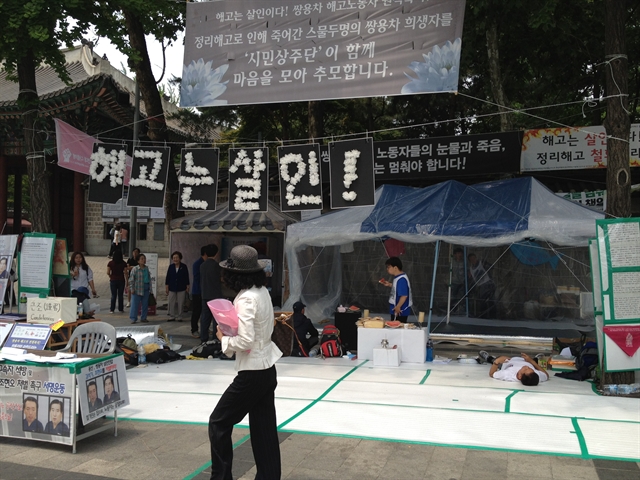
To this day, the laid off Ssangyong Motors workers are protesting in Seoul, by setting up a memorial for the 23 workers who died. They demand the laid off workers to be re-hired, and mass layoff to be abolished.

Memorial for Ssangyong Motors labor union. The large letters say: "Layoff is Murder."
(source)
The story of Ssangyong Motors is an epitome of how Korean society changed since 1997, and how that change has been driving ever more Koreans toward suicide. I have received many objections so far that essentially said there was something about traditional Korean culture that encouraged suicide. Not so--because if that's the case, how does one explain the fact that, in the 1980s, Korea enjoyed one of the lowest suicide rates in the industrialized world?

Until 1997, Korean economy was insulated from the harsher form of capitalism. Thanks to strong unions, employment was stable. Once you were in, you were in for life. Such job security is much more than just having money. It gives a sense of community and purpose, precisely the things that keep the suicide rates low in the pre-modern societies. Before 1997, working for a Korean company meant being a part of a team with several thousand members, with a genuine sense of camaraderie fostered through union activities.

Whether such system was sustainable through the course of economic vicissitudes is beyond my ability to answer. The simple fact is that, after 1997, the system was no more, and individualized capitalism has set in, violently. The striking Ssangyong Motors laborers suddenly fell from lower middle class to poverty. Their bodies and minds were damaged through the strike. Because of the strike, they were cut off from one another, and from the larger society. (Except to the minority of sympathetic ears, they were largely branded as "union thugs" and "rioters", deserving of a violent crackdown.)

But this is the most maddening thing about modern capitalism--there is no one to blame. At least, no one visible. Ssangyong management is an easy target, but they were only doing what the board of directors (i.e. Shanghai Motors) asked them to do. The laborers have no way to communicate to Shanghai Motors, nor do they currently have any way to communicate with Mahindra Automotive. Even if they could, there is no assurance that the foreign capital would be receptive to the traditional relationship between the union and the management. (Contrast this with Hyundai, which survived the 1997 financial crisis with its management intact.)

Facing this situation, it is very easy for the fired workers to begin blaming themselves. And in the world of neoliberal capitalism, such blaming is actually encouraged. (It would interrogate: "Why didn't you get more educated? Why didn't you acquire more skill? If you were just a little smarter, tried just a little harder, you would not be in the situation that you are in. Whatever happened to individual responsibility?") Even in a recession in which millions of competent people may lose their jobs through no fault of their own, the sway of such narrative is powerful. Once a worker who is fired and unable to find a new job buys into the narrative, his life is practically over. His social value became zero; he is a commodity whose existence no longer matters.

*              *              *

This is the conclusion of the series on suicide in Korea. One last takeaway: as a Korean American, I would like to urge Americans to take a close look at what happened in Korea for the last 15 years, because that is what will happen in America for the next 10 years. The social devastation of the 1997 financial crisis reaches far beyond the elevated suicide rate. In Korea, it has caused the middle class squeeze, ever-higher pressure for education (as it is seen as the only way to improve the worth of human capital,) higher rate of violent crime and more dysfunctional political culture. The sociological consequences of America's transition into the lean economic times probably will not be as drastic as Korea's, as America has a longer experience of living in modern capitalism. But many of the social ills that Korea went through as a result of its financial crisis are appearing in America now. To address them, America would do well to look to what happened in Korea, and how Korea succeeded and failed to address those issues.

Got a question or a comment for the Korean? Email away at askakorean@gmail.com.

Senin, 04 Maret 2013

Minggu, 03 Maret 2013

Fast Times with USFK

When PSY's anti-American lyrics made the news, the Korean wrote that there have been plenty of occasions with the U.S. military in Korea that were enough to make Koreans to lose their temper and say, "fuck these people." In the Korean's opinion, that does not excuse the excessive severity of PSY's language, but that does help one understand where he was coming from.

What happened recently in Seoul is exactly the type of thing that the Korean was talking about:
According to Seoul's Yongsan Police Station, police received calls shortly before midnight Saturday that two American soldiers, including the injured, were threatening civilians with an air gun in the multicultural district of Itaewon.

The two U.S. soldiers were approached by Seoul police near Itaewon Station, but they refused to identify themselves and fled in a vehicle, leading to the car chase through the capital city.

When they came to a dead end in southeastern Seoul, police fired off a warning shot and three rounds of bullets as the vehicle tried to rush through police officers despite warnings. The car's driver was hit by one of the bullets and another officer was slightly injured in the process, according to police.
One U.S. soldier shot by police in car chase [Yonhap]

The news report in Korean is more detailed. The car with U.S. soldiers topped at 170 km/h (~93 mph) and the chase lasted between 10 to 15 minutes. At the dead end when the police finally stopped the car, the U.S. soldiers attempted to get out of the jam by running over the police. After being shot by the police, the soldiers actually drove away and escaped into the base, and in the process ran over the police officer's foot. Why were they so desperate to get back to the base? Because once they are in the base, Korean police cannot interrogate them unless the USFK voluntarily turns them over. By the way, one of the soldiers was a staff sergeant.

So, to reiterate: a foreign army is occupying the middle of the city, and some of them are dumbasses who were threatening civilians with guns, engaged in a late night car chase, tried to kill a police man and got away with only injuring him in the process. And Koreans cannot do anything about it unless USFK voluntarily turns the soldiers over, and good luck getting that to happen. 

Try putting the shoe on the other foot here, and imagine something like this happening, say, in the middle of Manhattan around once a month, for decades. How fast do you think somebody in America would say, "fuck these people"? How long do you think it would take before a celebrity singer, who lets his emotion run high and does not quite think things through, makes a song about killing them?

The Korean cannot tell you to feel one way or the other. If you feel that, even under these circumstances, nobody may ever be forgiven for making an ill-advised, excessively emotional song, go on and feel that way. But one does have to wonder how reasonable that position is.

Got a question or a comment for the Korean? Email away at askakorean@gmail.com.

Sabtu, 02 Maret 2013

Korea's Gunless Fight Against Tyranny


The memorial near Sandy Hook Elementary School
(source)

Regular readers of this blog are probably well-acquainted with the Korean's aversion to American gun culture. In the wake of the Newtown Massacre and the gun control debate that followed, Andrew Sullivan, popular political commentator and an immigrant from Great Britain, wrote:
Gun violence is one of those things that an immigrant is first amazed by in America. The second thing a non-American is shocked by is the sheer passion of those who own and use guns in this country.
As an immigrant to the United States, I share that sentiment. America’s gun violence, and its love for guns in the face of such gun violence, make no sense to me. To be sure, I understand the recreational value of guns: if you like hunting, for example, I have no objection that you love your hunting rifle. But we all know that the current gun debate is not about hunting rifles--it is about the widespread and under-regulated gun ownership.

Because I so relentlessly advocate for strict gun control, I have encountered equally relentless counter-arguments from gun advocates who would not countenance any regulation of their firearms. From those encounters, I found that every pro-gun argument falls into one of five categories. They are:
  1. Red herring: "Guns are not the problem; violent video games/mental healthcare/racial minorities are the problem."
  2. Legal:  "Gun ownership is a fundamental right guaranteed by the Constitution."
  3. Public policy:  "More guns prevent crimes."
  4. Pragmatic:  "It is not practically possible to eliminate guns from the United States."
  5. Political philosophy:  "Civilian gun ownership prevents tyranny."
All five of them are wrong, and it is quite easy to show how they are wrong. The first argument is a genuinely dishonest red herring. When pressed, even gun advocates have to admit that guns make deaths happen much more easily and efficiently. Whatever murderous tendencies Americans may have, there is no question that guns provide an easy connection between murderous tendencies and actual deaths. A data point here would suffice: suicidal acts with guns are fatal in 85% of the cases, while suicidal acts with pills are fatal in 2% of the cases. (This is why we arm our military with guns, not pills.) And regulating a single category of item makes much more sense than, say, putting every single American through mental examination or pre-screening all video games to make sure none of them is too violent.

The legal argument is also wrong. Here, I particularly delight in exposing the self-made constitutional scholars, since I wrote a lengthy paper about the Second Amendment implications before District of Columbia v. Heller was decided in 2008. To be sure, Heller was a laughable decision. It was a 5-4 decision a la Bush v. Gore, i.e. straight along the partisan line. More importantly, Heller--which was decided only five years ago--was the very first Supreme Court case ever to find that the Second Amendment guaranteed individual rights of gun ownership, even though the Second Amendment has existed for more than 200 years. In doing so, the five conservative justices of the Supreme Court overturned hundreds of years of legal precedents that have held, consistently, that there is no individual right to gun ownership under the Constitution.

But even if we are to treat Heller as the law of the land--and we must, out of respect for the Constitution--the Heller opinion itself clearly leaves room for increased gun ownership control:  “nothing in our opinion should be taken to cast doubt on . . . laws imposing conditions and qualifications on the commercial sale of arms.” In short, there is nothing unconstitutional or illegal about, say, banning all assault weapons or high-capacity magazines from civilian ownership. Likewise, there is nothing unconstitutional or illegal about instituting a gun buy-back program, or imposing a significant amount of tax on every gun and bullet sold (as long as the tax is not so great that it effectively acts as a bar to ownership,) or requiring every gun owner to purchase a liability insurance.

Public policy argument is just as easy to dispatch. Numerous studies confirm again and again that having guns at home doubles the risk of homicide. This holds true at an international level as well. Among developed countries, United States has incomparably high gun ownership rates, and likewise has incomparably high rates of both gun-related homicide and ordinary homicide. The developed countries that do have high (but nowhere nearly as high as U.S.) rate of civilian gun ownership have a level of gun control that would be unimaginable in the current-day United States. Switzerland, for example, requires that the citizens keep all their bullets in the army barracks.

The pragmatic argument appears to be sensible in the first blush, but quickly loses its strength in the face of a real world example. After a mass shooting in 1996, Australia instituted a gun buy-back program that reduced the civilian ownership of guns by 20%. In the next 10 years, Australia's firearm-related homicide plunged by 59%, while non-firearm homicides remained the same. What is more, the firearm-related homicide dropped more precipitously in Australian states that had higher gun buy-back rates. (As a bonus, firearm suicides fell by 74%.) In fact, Australia's example shows the hollowness of the "public policy" argument as well. In all likelihood, only law-abiding citizens would participate in a gun buy-back program. Then how is it that gun-related homicide dropped by nearly 60%, when (according to gun advocates) only "bad guys" would have guns?

That leaves us the "political philosophy" argument--the idea that we need guns to overthrow tyranny. And this is the real reason why I write this post, to address this risible argument.

(More after the jump)

Got a question or a comment for the Korean? Email away at askakorean@gmail.com.


Of the five arguments against stricter gun control, this "political philosophy" argument is personally the most grating. It is not just that the argument is wrong; the other four arguments are wrong as well, but they do not grate me as much. People are often wrong, and with enough facts and data, they can be shown wrong. This is a process that we go through all our lives, and peace of mind would be difficult to attain if this process unsettles you.

To me, the political philosophy argument is grating not because it's wrong; it is because the argument is absurd. A typical American gun advocate simply has no idea what it’s like to live in an actual, real-life tyranny, because America is the oldest and strongest democracy in the world. (And it is quite telling that the sub-population of Americans who did experience real-life tyranny, e.g. African Americans, are nowhere to be found among contemporary gun advocates.) Because American tyranny only exists as a fantasy, American response to the potential coming tyranny is also fantastical--thus, we have such risible statements as "there would have been no slavery if African Americans had guns" or "there would have been no Holocaust if Jews had guns." Yet the true believers can go on saying these absurdities for one simple reason: it is particularly difficult to have a counter-example that is "within all fours," as lawyers like to say. 

But there indeed is such a counter-example. South Korea suffered under tyranny for 40 years, then achieved freedom without resorting to armed revolt. But before they did, South Koreans tried an armed revolt first. That's the story I would like to tell here.

*             *             *

Although North Korea grabs all the headlines for its totalitarianism, it is lost on most people that, for the first few decades of its existence, South Korea was not much better than its northern brethren. The current Republic of Korea (South Korea) was established in 1948. Although nominally established as a democracy, the country was not fully democratized until 1987.

In the four decades between its birth and full democratization, South Korea would undergo three fascist dictators. The first one, Syngman Rhee (who was also South Korea’s first president,) ruled for 12 years by rigging elections at first, then later declaring himself to be the lifetime president. A popular protest overthrew him and established a democratic government. (Rhee fled to Hawaii, where he died.) That democratic government lasted a year and a half, until the second dictator, Park Chung-hee, rolled into Seoul with tanks to depose the democratic government. He, too, rigged elections and declared himself to be the lifetime president. Park proceeded to rule the country for 18 years, until he was assassinated. Amid the chaos that followed, the third dictator--Chun Doo-hwan--again rolled into Seoul with tanks and anointed himself to be the president. He ruled for 7 years, until 1987.

When I say Rhee, Park and Chun were fascists, I literally mean the term “fascists.” They were real, true fascists who commandeered the Korean economy and fattened their own coffers. (Chun was found to have collected more than a billion dollars during his seven-year reign into his slush fund, a staggering sum for South Korea of the 1980s.) They held up newspaper editors at gunpoints and dictated what the newspapers should say. If the Korean people criticized their rule, they were beaten, tortured and killed. If a leader emerged in the opposition, they jailed and/or assassinated the leader.

Yet today, South Korea boasts the most robust democracy in East Asia. In 2013, it is virtually unimaginable that South Korea would backslide into another round of military rule. South Korean democracy is operates efficiently enough to foster its world-class corporations. South Korean democracy creates peaceful resolutions to fractious political issues in accordance with the rule of law. In its quarter-century history, South Korean democracy already experienced two peaceful transitions of power--conservative to liberal, then again to conservative. 

What is more, South Korean democracy serves its essential function: check the excesses of power in accordance with the rule of law. In 1996, the democratic Korean government successfully prosecuted Chun Doo-hwan to life in prison. When the sons of presidents Kim Young-sam and Kim Dae-jung were alleged to have received bribes, Korea’s justice system investigated them and put them into jail. When president Roh Moo-hyun in 2004 was alleged to have violated election laws, he was impeached. Korea’s press serves their rightful role as the watchdog, being independent (albeit with commonplace journalistic slants,) loud and activist.

In short, South Korea is a free country--although, only a quarter century ago, it was not. And Korean people managed to achieve this peacefully, without resorting to guns.

*                 *                 *

I have told this story enough times to know that, right around this point of the story, the gun advocate would interject: “But you never know what would have happened if Koreans did have guns. If Koreans had guns, the dictatorship may have fallen in 10 years or 20 years instead of 40.” But actually, Koreans did try the armed insurrection option first.

The second dictator, Park Chung-hee, was assassinated in October 1979. But the Korean people’s brief hope for democracy was almost immediately dashed, when Chun Doo-hwan rolled into Seoul with tanks in December 1979. For the first few months afterward, Chun attempted to co-opt the democratization activists into his faction, hoping that the activists would support the military’s role in politics. But Korea’s democratization activists soon saw through Chun Doo-hwan to be as much of a dictator as Park Chung-hee. In early May 1980, the activists resumed their demands for democracy and protests in the streets. In response, on May 17, 1980, Chun Doo-hwan declared martial law nationwide, dissolved the National Assembly and arrested 2,699 opposition leaders and democratization activists. Pursuant to the martial law--which is really no law at all--Chun Doo-hwan sent the military to all major cities to quell any organized opposition to his ascendance. One of the objectives of the military was to drive out the students from college campuses, traditionally the epicenter of democratization movement.

In the southwestern city of Gwangju, the sixth largest city in Korea which many of the democratization movement leaders called home, the protesters took a stand. On the morning of May 18, the day after the nationwide martial law was declared, some 800 Jeonnam University students gathered outside of the gates of their campus in Gwangju, and demanded the paratroopers who were guarding the gate to step aside, so that they may attend their classes. The paratroopers beat the students with billy clubs; the students responded by throwing rocks at the paratroopers. Students then retreated into the city; the paratroopers gave chase, and began indiscriminately beating any Gwangju citizen who got in the way.

Paratroopers beating Gwangju citizens, on May 19, 1980.
(source)
The next day, Gwangju was in a full-blown rebellion with tens of thousands of protesters, as regular Gwangju citizens, enraged by the paratroopers assault on the city, joined the student protesters. The military government sent reinforcement, with orders for a more brutal crackdown. Paratroopers were now armed with bayonets, and went on a beating and stabbing rampage across the city. They would kill the first Gwangju citizen that day; a thirty-year-old deaf man was dead from brain hemorrhage after having been beaten from the paratroopers. The fight continued the next day, with the protesters setting up barricades and raining rocks upon the paratroopers. The events would take a fateful turn at around 11 p.m. on May 20. At the Gwangju train station plaza, the paratroopers opened fire to the protesters. Three protesters died on the spot; dozens more were injured. Having learned that the military government was ready to shoot and kill civilians, the citizens of Gwangju began to arm themselves.

This scene might warm the heart of an American gun advocate. Indeed, this scene may as well be the exact type of romantic image that the “we-need-guns-to-fight-tyranny” folks have been dreaming of. Because the citizens of Gwangju were able to raid the nearby military armories, they were armed with military grade weapons, including walkie-talkies, assault rifles, M2 machine guns, hand grenades and TNTs. The citizen militia even had KM900 armored cars (!) as they raided an automobile plant in Gwangju that manufactured armored cars. What is more, Gwangju’s citizen militia actually knew how to properly use these weapons. Because nearly every Korean male served (and still serves) two years of mandatory military service, Gwangju’s citizens did not face a deficit of disciplined organization against the incoming military government’s forces.

In fact, the entire city of Gwangju organized with discipline. Although there was no police or any other law enforcement, there was no looting or disorder. Although every man was armed, there was no robbery. The citizen militia took over the local granary and distributed food in an orderly fashion. Those with medical training volunteered to tend the wounded; people lined up to give their blood. Womenfolk delivered food, ammos and messages to the militia in the forward positions. Most importantly, just like they learned in the military, the armed citizens of Gwangju fortified key buildings of the city, and waited for the advance.

Women of Gwangju preparing rice for the civilian militia. Photo taken on May 22, 1980.
(source)
(For more photos of the Gwangju Uprising, visit the official online photo archive here.)

The city would remain free for one week. On May 27, 1980, the paratroopers, escorted with tanks, overran the provincial office of Gwangju, the citizen militia’s last holdout. The entire episode--later termed Gwangju Democratization Uprising--claimed more than 600 lives, including eight young children under the age of 14. More than three thousand Gwangju citizens were injured; nearly 1,600 people were arrested, and were tortured for days, months. The trauma from the arrest was so great that more than 10 percent of those arrested committed suicide after release.

*               *               *

Does freedom require civilian gun ownership? If your answer is yes, here is a follow-up question--why is it that so many oppressed people around the world, who are keenly aware of their oppression and are doing everything to fight for freedom, are not clamoring for the right to civilian gun ownership? American democracy is the envy of the world, the ultimate model for the emerging democracies. How is that none of those emerging democracies have guaranteed a right to civilian gun ownership, even as they emulate American democracy?

This was also the case for the South Korean democracy, which was explicitly modeled after the American one--after all, the first constitution of South Korea was practically written by American attorneys and legal scholars. Korea’s democratization activists enthusiastically called for all the peculiar features of America’s democracy to be incorporated into Korean democracy, such as freedom of speech and press or the checks and balances of the three branches of the government. 

But not civilian gun ownership. In fact, South Korea has been one of the most gun-free societies in the world from the beginning of the republic, through the military dictatorships and as a democracy today. This is not because Koreans are effete sissies who are irrationally afraid of guns. Nearly every Korean male serves his military duty, during which he constantly handles weapons. Indeed, as a society, Korea may have a healthier “gun culture” than the U.S., since everyone who is likely to handle firearms undergoes a rigorous and proper training. Yet, even in the face of the murderous tyranny, Koreans did not even consider the possibility of demanding civilian gun ownership. Why?

Because Koreans understood that freedom is a social movement. Freedom is not a piece of golden fleece that a bullet-spraying, Rambo-like hero can snatch off from a mythical beast. (Indeed, only someone who never truly experienced tyranny--i.e. majority of Americans--would think this way.) Your ability to fend off one or two lackeys of the dictatorship who are coming to arrest you means nothing, when the dictatorship can easily send one or two dozen more. As we could see from Gwangju, even a whole city organized and armed is no match for the tyranny that is able to bear down the rest of the country’s forces upon that city. Freedom in a society happens when, and only when, that entire society demands freedom. When the entire society earnestly demands freedom, even the most murderous tyrannies are rendered powerless.

Only seven years after the massacre in Gwangju, South Korean citizens would prove this point. On January 14, 1987, a student activist Park Jong-cheol was killed while being waterboarded under police custody. The Chun Doo-hwan dictatorship initially attempted to cover up the death. But on May 18, 1987, at the seven-year memorial mass of the Gwangju Uprising held in Seoul, Father Kim Seung-hoon revealed that Park in fact died because of torture. Another round of protest erupted across Korea. On June 9, 1987, Yi Han-yeol, another student activist was fatally wounded by a tear gas shell while marching in the ensuing demonstrations.

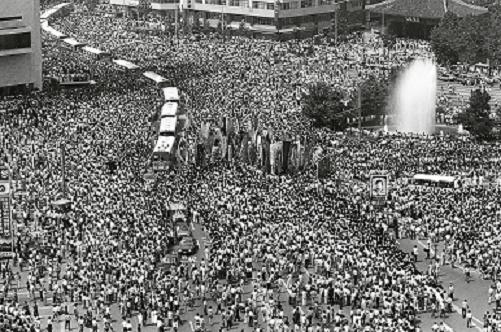
Citizens of Seoul march in the June Struggle, with a giant photo of Lee Han-yeol in memoriam.
(source)
Korean people have had enough. Over the next three weeks, the country would erupt in waves of protests, at a scale never seen before. The Chun dictatorship deployed 60,000 armed police to crack down the protests, but the police was overrun by the sheer number of the protesters. The protesters were no longer just college students; they were priests in robes, high school students in uniforms, white collar workers in suits. The protesters asked the drivers to show their support for the movement by waving white handkerchief out of their windows while honking their horns as they passed by the protesters. It was an incredible scene: the streets of Seoul were a cacophonous din of white, with every car pressing down on its horns and waving a white handkerchief.

The protests crested on June 26, when more than 1.3 million Koreans marched for democracy in 37 cities across the country. Three days later, Chun Doo-hwan capitulated and issued a statement promising direct elections and transition to true democracy. In December 1987, South Korea would hold the first free and fair presidential election in the republic’s history. Thus, Koreans achieved what Mahatma Gandhi achieved in India, what Martin Luther King Jr. achieved in America--they defeated tyranny without guns.

Got a question or a comment for the Korean? Email away at askakorean@gmail.com.

Jumat, 01 Maret 2013

Korean Statistic of the Day: U.S. in the Red

[This title seems to be a more accurate description of the new gimmick item.]

In 2012, America's trade deficit against South Korea increased by 25 percent compared to 2011. The dramatic change is mostly attributed to Korea-U.S. Free Trade Agreement. Much of the deficit came from the automobile industry, as the U.S. deficit in the auto industry against Korea increased by 22 percent compared to the previous year. The U.S., however, managed to significantly reduce its deficit in the electronics/space/IT industry, going from $6.2 billion in deficit to $1 billion in deficit.

Got a question or a comment for the Korean? Email away at askakorean@gmail.com.